



 Facebook
 Reddit
Director Aki Kaurismäki's latest is a humanist hug of a fable which concludes that while big miracles may happen, it's the everyday 'miracles' people create for one another that really count.
The port of Le Havre suggests greyness and grit, especially if you throw in an illegal immigrant plotline. Interestingly, Le Havre and fellow recent French film, The Fairy - though both set there and dealing with the issues of migration - shy away from the murk of realism in favour of presenting fairy tales considering the kindness of strangers and the darker flipside to that. Somehow, despite this rather idealistic sounding stance, both - and particularly Le Havre - use absurdity to avoid being trite.
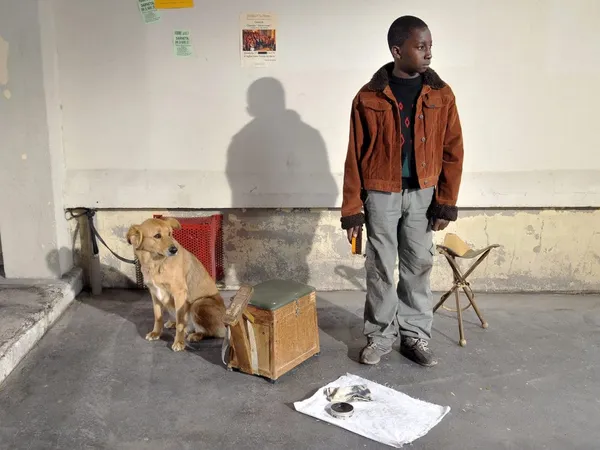
 Marcel (André Wilms) is a French shoe-shiner. He says his "profession is closest to the people and the last to respect the Sermon on The Mount" - a typical Kaurismäki line, fiercely funny and enigmatic. With the advent of trainers, business is on its uppers but his life, with is faithful dog Laika, is not particularly any more impoverished than the other working-class denizens of the district he lives in. Kaurismäki quickly creates a sense of community and neighbourliness, although Marcel's wife Arletty (Kati Outinen) is taking thinking of others to extremes, refusing to let doctors tell her husband she is dying.
There's not too much time to think about that, however, as immigrant youngster Idrissa (Blondin Miguel), on the run from the docks and the cops, seems to be in altogether more urgent need of help. Marcel and his pals hatch a plot to raise cash to ship the kid to his mum in England before local French flic (Jean-Pierre Daroussin) finds out.
The story is simple but the humour and references run deep, from the names - Marcel's surname is Marx, Arletty recalls the French actress and singer of the same name, known for her working-class roles - to the casting of absurdist director Pierre Etaix in a bit part. Kaurismäki and cinematographer Timo Saminen's stylisation - with cool blues dotted with startling outbreaks of colour, retro outfitting and a deadpan edge - is anywhere and nowhere simultaneously, which neatly plays into the overall idea of port towns being places of transition and transport and into considerations of universal humanity. And if Kaurismäki's deadpan humour doesn't indulge in the same level of slapstick clowning as Charlie Chaplin or Etaix, there's a shared sensibility, with serious social commentary underlying the comedy.
While the film's tangible warmth brings with it a reasurring endorsment of the French motto "liberty, equality, fraternity", it also has an enigmatic and questioning air - this may be a funny little fairy tale but, Karusmaki asks us, isn't it a shame that more of us don't try to turn it into a reality?
Reviewed on: 22 Feb 2012

If you like this, try:
Review preview for The Fairy
The film has a better narrative flow than their earlier movies, although some of the gags inevitably work better than others.
Review preview for The Great Love
A film that's a bit hit and miss but that, at its best, provokes uproarious laughter, and succeeds in charming throughout.
Review preview for Modern Times
Contains some of the little tramp’s most iconic movie moments.
Review preview for The Other Side Of Hope
The director has a flare for encapsulating a world of emotion in a single moment.